


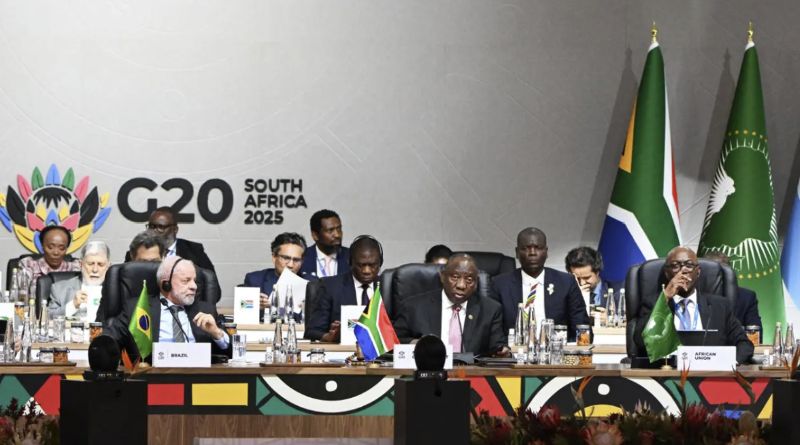
1. OVERARCHING THEMES
“Solidarity, Equality, Sustainability” — the summit’s official theme.
Specific focus on Africa, Global South priorities, and global financial reform.
Commitment to multilateral cooperation despite deep geopolitical tension.
2. KEY CONTENT OF THE DECLARATION (10-POINT SUMMARY)
Global Financial Reform
Calls for overhauling the global financial architecture.
Pushes for reforms in IMF, World Bank & credit rating systems.
Emphasis on easing the debt burden on developing countries.
Sovereign Debt Relief
Strengthening the Common Framework for Debt Treatment.
Faster restructuring for heavily indebted developing countries.
Industrialisation for Africa
Commitment to value-add production in Africa (not just raw extraction).
Support for African supply chains, green minerals, and manufacturing.
Job Creation & Labour Protections
G20 Employment Track priorities endorsed:
“productive employment, decent work, and social protection.”
Encouraging investment into skills, youth employment & tech sectors.
Trade & Market Access
Support for fairer and more diversified global trade.
Opposition to unilateral trade restrictions and protectionism.
Climate & Clean Energy Transition
Push for renewable energy investment.
Climate-finance commitments (not quantified).
Adaptation support for vulnerable countries.
Digital Transformation
Support for digital public infrastructure.
Guidance on data governance, cybersecurity & bridging the digital gap.
Health Systems & Pandemic Preparedness
Commitment to strengthening Africa’s vaccine and medical manufacturing.
Support for global surveillance & emergency response mechanisms.
Food & Water Security
Addressing global food supply shocks.
Improving agricultural resilience & sustainable farming.
Global Peace & Stability
Generic call for peaceful resolutions to conflicts.
No explicit unified stance on Gaza, Ukraine or Sudan (due to division).
✅ 3. WHO AGREED TO THE DECLARATION
The declaration was officially adopted by the G20 as a whole — but with major caveats.
✔️ Countries that agreed / signed on (majority)
(All regular G20 members except the USA and Argentina):
South Africa (host)
China
India
Brazil
Russia
European Union (EU)
United Kingdom
France
Germany
Italy
Japan
South Korea
Saudi Arabia
Turkey
Indonesia
Mexico
Canada
Australia
African Union (permanent member)
❌ 4. WHO DID NOT SIGN / WITHDREW CONSENT
United States – BOYCOTTED
The U.S. boycotted the summit entirely.
The White House openly told other countries NOT to sign.
Reason: objection to South Africa’s “Global South framing” and language around financial reform.
Argentina – DID NOT ENDORSE
Argentina formally indicated it did not endorse the final declaration.
Reason: ideological alignment with U.S. position under its new administration.
⚠️ 5. WHO EXPRESSED RESERVATIONS (BUT STILL LET IT PASS)
Japan
Signed the declaration but expressed reservations regarding:
wording on financial governance
references to energy transition speed
Did NOT block the consensus.
UK
Signed, but voiced concerns about anti-IMF wording.
Supported South Africa’s general agenda but resisted language on “unfair debt systems.”
EU members
Signed unanimously, but certain paragraphs required negotiation due to geopolitical references.
🔍 6. WHY THE DECLARATION MATTERS
South Africa achieved one of the most pro-Global-South declarations in G20 history.
It elevates Africa’s voice on:
debt justice
inequality
industrialisation
fair trade
climate finance
The U.S. boycott makes the declaration symbolically powerful — a visible shift in global alliances.
📌 7. BIG TAKEAWAY
The 2025 Johannesburg Declaration is the first G20 declaration in history adopted without the United States — a seismic moment in global politics.
It positions:
Africa at the centre,
South Africa as a diplomatic force,
And financial justice as a global priority.

