


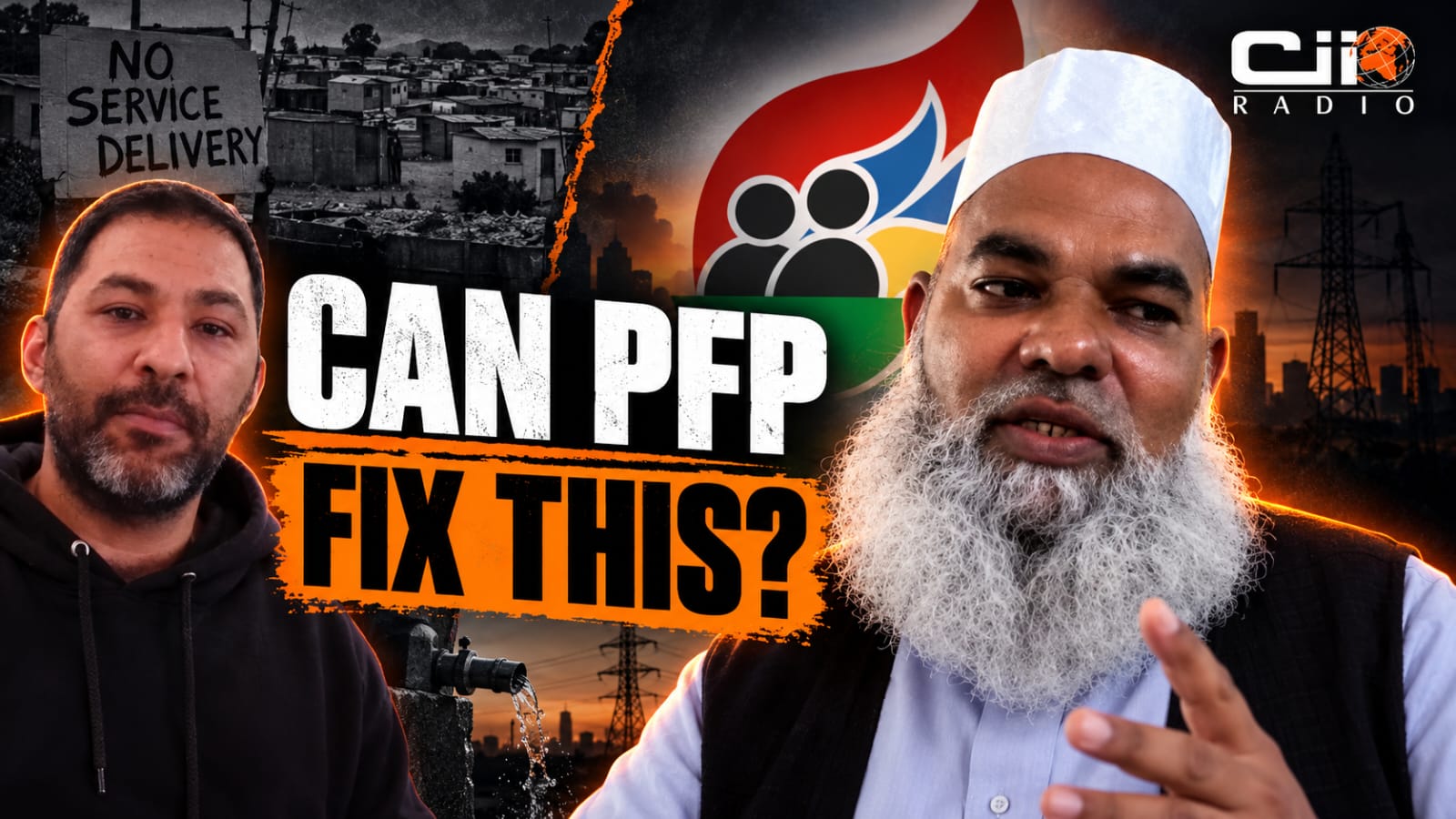
“Why should anyone believe that your party will deliver what the established parties have failed to deliver?”
That was the challenge veteran journalist and lawyer Liaaqat Tobias put to Moulana Muhammad Tariq in a Cii Radio interview about the People’s Freedom Party. It is also the question every emerging political party eventually has to answer: what makes you different once the campaign slogans are stripped away? Tariq’s case for the PFP rests on a deliberately ordinary list of things: water from a tap, shelter, accountable budgets, cleaner government and leaders who remain visible after election day.
Why the PFP says it was formed
Tariq traced the party’s origins to a loss of public faith in established politics. He said his work in Phoenix during Covid-19 and the July unrest exposed frustration with political infighting and a feeling that ordinary communities had been forgotten.
The PFP contested the 2021 local elections and, he said, secured a proportional-representation seat in eThekwini within months of forming. For Tariq, that seat is less important as a trophy than as a test: can a small party turn community work into measurable local delivery?
His pitch to voters was direct: “You’ve tried the rest. We have a track record. We’ve been on the ground.”
The politics of a working tap
The interview was strongest when it left ideology behind and moved to the daily experience of municipal failure. Tariq’s clearest line was about water.
“We can’t live our life on water tankers and JoJo tanks,” he said. “When you open the tap, water should come out.” That sentence captures the PFP’s broader argument. Tariq linked corruption and weak accountability to housing shortages, unreliable services and public frustration. He argued that politics should be judged by what happens at ground level rather than by the size or history of a party. When Tobias asked whether South Africa’s deeper problem was failed leadership or failed political accountability, Tariq chose the latter: “I think it’s a failure of political accountability.” He repeatedly returned to the need for the public to know how budgets are spent and what government is buying with public money.
Faith without becoming a party for one faith
Tobias also pressed Tariq on an obvious tension: how does an imam and alim allow religious conviction to shape his politics without turning the PFP into a Muslim-only platform? Tariq did not try to blur his identity. “I won’t compromise my religious beliefs,” he said, before adding: “But it’s a platform for all. It’s a platform where everyone can join us.” That principle was tied to his long involvement in multifaith and multiracial community structures in Phoenix. He presented the party as values-driven rather than religiously exclusive — a distinction the PFP will have to demonstrate in practice if it wants to grow beyond its existing base.
Burials, consultation and the limits of regulation
The interview also moved into a specifically Muslim civic issue: government policy that can affect burial practices. Tariq’s answer was less about rejecting regulation than about process. If the PFP had influence, he said, one of the first steps would be to “consult with religious leaders” and ulama bodies before rules are implemented in ways that create religious hardship. The larger democratic point is straightforward: policy works better when the people most affected are in the room before a decision is made.
Coalitions: service before positions
With coalition politics becoming increasingly important in South African local government, Tobias asked what the PFP’s non-negotiable conditions would be when working with other parties. Tariq answered: “Our first condition will be service delivery.” He went further: “This is the priority. We won’t look for positions. We won’t just want to say, listen, we want to enrich ourselves. The community would be at heart.” That promise is easy to make and difficult to prove. The value of the answer is that it gives voters a clear standard against which to measure the party later: if coalition negotiations become about posts rather than services, the interview itself becomes a record of what was promised.
The human side of the campaign
One of the less conventional parts of the interview was Tariq’s “Every Child Is My Child” campaign. He spoke about school shoes, feeding initiatives and sanitary support for children. It is a reminder that local politics is often won or lost far away from parliament — in schools, community halls and households under pressure.
The final test: why should anyone believe you?
Tobias ended with the most sceptical question of the interview: “If a voter listening right now says, ‘I’ve heard all of these promises before — give me one reason to believe you,’ what would you tell them?” Tariq replied: “Firstly, I won’t speak lies. I won’t steal. And I will make sure that whatever we are saying we’ll deliver, we are going to deliver.” He then explained why personal visibility matters to him: as an imam and community figure, he said, he has to face the same people again after the election. That is ultimately the PFP proposition in one sentence: proximity as accountability. Whether that produces better governance can only be judged by results, but the interview gives voters a clear set of promises to remember.
Why does Muhammad Tariq say the People’s Freedom Party was formed?
He says the PFP emerged from frustration with poor governance, political infighting and declining public trust in established parties.
What are the PFP’s main priorities according to Tariq?
He emphasised basic service delivery, water, housing, accountability, clean governance and support for poor and vulnerable communities.
Is the People’s Freedom Party only for Muslim voters?
Tariq said he would not compromise his religious beliefs but described the PFP as a platform open to people of all religions, races and cultures.
What did he say about coalitions?
He said service delivery should be the first condition and argued that coalition negotiations should not be driven by positions or personal enrichment.

