


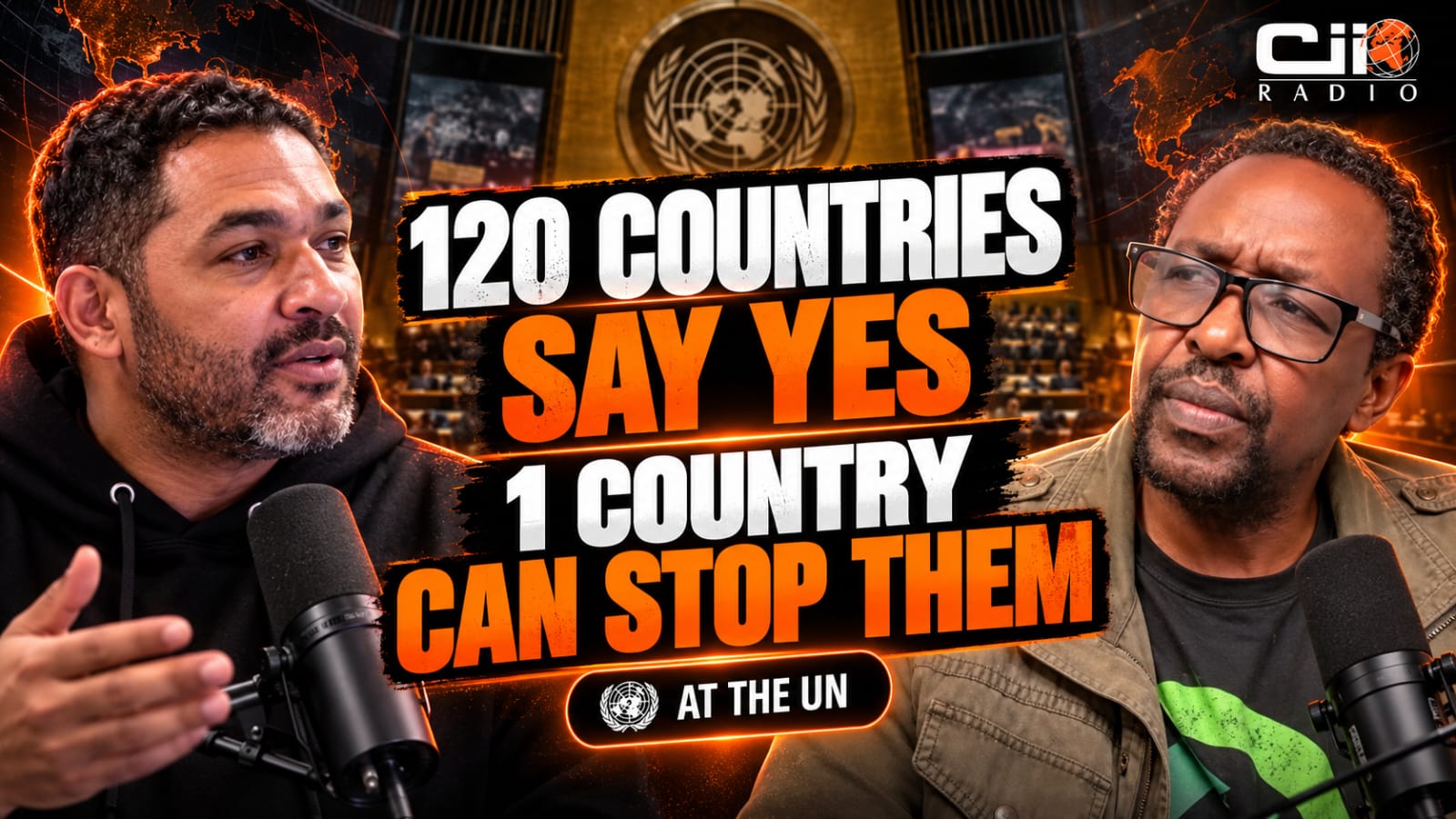
UNGA81 exposed a basic power problem at the United Nations, Dr Trevor Ngwane argues: many countries can support a position, yet a permanent Security Council veto can stop it. Speaking to Cii Radio’s Liaaqat Tobias, he said the UN is still needed for dialogue but requires deep reform.
At the UN, numbers do not always equal power.
That was the contradiction at the centre of Cii Radio’s conversation with Dr Trevor Ngwane after the 81st United Nations General Assembly debate. Veteran journalist and lawyer Liaaqat Tobias opened with a question that cut past six days of diplomatic speeches: “Is the United Nations still capable of changing the world, or has it become a stage where governments simply come to make speeches?” Ngwane’s answer was more complicated than a simple “yes” or “no”. He criticised the way the institution is structured, but resisted the idea that the world would be better off without a global forum. “Although I’ve got a serious criticism of the UN,” he said, “probably the world still needs a structure like this.”
Why the veto matters more than the vote
Ngwane’s sharpest criticism was aimed at the concentration of power in the UN Security Council. His argument was simple enough to explain without diplomatic jargon: countries may be formally equal in the wider UN system, but a small group of permanent powers can block decisions through the veto. He put it this way: “120 countries can vote for something, but the USA or Russia or China can just exercise their veto, and then that policy is blocked.” The point matters because the UN is often judged by what the world appears to agree on. Ngwane argued that public majorities in the General Assembly can carry moral and political weight while still failing to produce enforceable action when the power structure above them does not move.
Gaza has become a test of the UN’s credibility
That tension was especially visible in the interview’s discussion of Gaza and Palestine. Tobias asked what the international response to the war in Gaza says about “the credibility and the limits of the UN system”. Ngwane responded by pointing to what he saw as both progress and contradiction. He described the latest UN gathering as “one up for Palestine and the people of Gaza”, because of the direction of international opinion in the assembly. But he immediately returned to the structural limitation: General Assembly votes may signal where governments stand, yet they do not automatically override the Security Council’s veto politics. This distinction is important for audiences trying to understand why a dramatic UN vote can dominate headlines without immediately changing events on the ground. In Ngwane’s reading, the UN can reveal a global political shift before it has the institutional muscle to enforce it.
Africa’s representation problem
Africa’s place in global decision-making was another major theme. Tobias asked why, after decades of demands, the continent still lacks a permanent Security Council seat with the same status as the veto-wielding powers. Ngwane’s response was blunt: “Power is never handed to anyone on a plate. You have to fight for it.” He also turned part of the criticism back on African governments, arguing that leaders who demand greater democracy internationally must also confront repression and inequality at home. His proposed response for South Africa was regional rather than symbolic. He said South Africa should “go back home”, convene SADC and African Union partners, and help build a more unified campaign around progressive demands rather than relying only on speeches in New York.
AI: the new global power struggle
The conversation then widened beyond war and institutional reform. Ngwane noted the huge growth in attention given to artificial intelligence at the UN and warned that the technology could reshape industry, warfare and political power. He argued that African concerns about AI governance deserve serious attention because the rules risk being set by powerful actors in the Global North and imposed on countries in the Global South. In his words, the development of AI governance can follow “the old colonial model”. At the same time, he acknowledged that AI could help address problems such as food production and climate change if access and control were more broadly shared.
The deeper argument: inequality drives instability
Underneath the discussion of vetoes, Gaza, AI and diplomacy was a broader political diagnosis. Ngwane repeatedly returned to economic inequality and the way competition for resources shapes conflict. He linked marginalisation to racism, xenophobia and exclusion, arguing that global institutions cannot solve political crises while leaving the economic pressures that feed them untouched. That is also why his final answer landed so strongly. Asked what the world should take from the UNGA81 debate, Ngwane said: “We know what must be done, but our narrow economic interests won’t allow us to do it.” The interview leaves the audience with an uncomfortable question. The crisis facing the UN may not be that governments do not know what peace, representation and accountability require. It may be that the states with the most power have the least incentive to surrender it.
Interview conducted by Liaaqat Tobias, Veteran Journalist and Lawyer, for Cii Radio — Cii / Channel Islam International.
What was Dr Trevor Ngwane’s main criticism of UNGA81?
He argued that the UN remains useful as a global forum, but its Security Council structure allows a small number of permanent powers to block decisions through the veto.
What did Ngwane say about the UN veto?
He said large numbers of countries can support a position while a permanent Security Council member can still veto it, limiting the practical force of wider international consensus.
What did he say about Gaza and Palestine?
Ngwane said the direction of voting at the UN showed growing political support for Palestine, while also illustrating the limits of General Assembly decisions when binding action is blocked elsewhere in the UN system.
What role did he propose for South Africa?
He urged South Africa to work through SADC and the African Union to build a stronger, more unified regional campaign for reform and progressive global demands.

