


20 November 2025
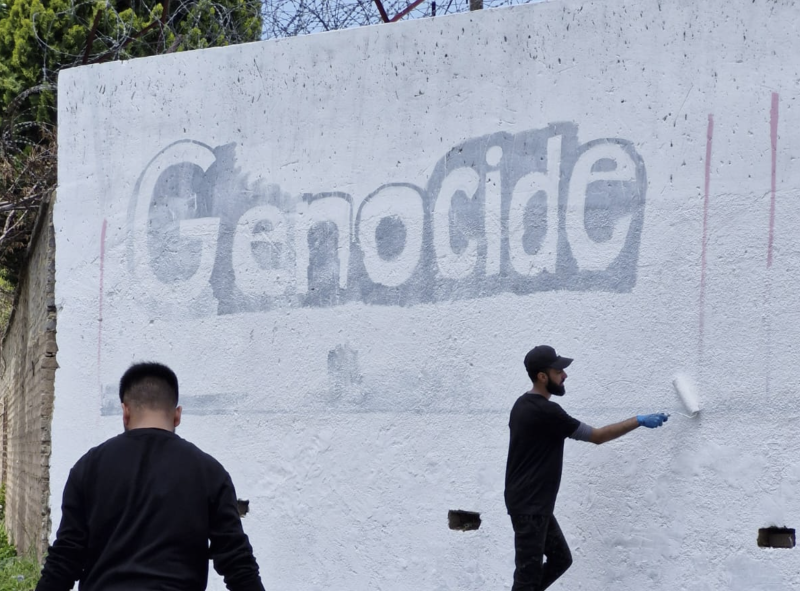
Artists and activists say officers arrived at the Palestine mural site on Thursday morning, told them to stop painting immediately, and ordered that the word “genocide” be painted over. They were told they could continue “next week after the G20,” because the mural might cast “negative light on the country” while world leaders are in town.
The wall itself belongs to private homeowners along Marlboro Drive; the artists have permission to paint there. The police argument is that, because painters are standing on public land and the wall faces a main road, the work falls under “Section 9” rules.
What is “Section 9” really about?
From court and municipal documents, “Section 9” in Johannesburg is normally used in the context of outdoor advertising by-laws, dealing with prohibited signs that are visible from public roads.
These rules were written to control billboards, commercial adverts and signage along roads — not to settle political arguments about what words foreign leaders may see when they drive past.
At the same time, South Africa’s Constitution guarantees:
Freedom of expression, including “freedom of artistic creativity.”
Equality before the law and protection against unfair discrimination.
Any by-law or police action has to be interpreted in that bigger constitutional light. When “Section 9” is used to silence the word “genocide” during a summit, but suddenly becomes relaxed once the G20 has left, it raises an obvious question:
Is this about safety and by-laws — or is it about shielding powerful people from an uncomfortable truth?
Why the word “genocide” matters
The word on that wall is not random.
A rights group, Euro-Med Human Rights Monitor, says that even after a declared ceasefire, Israel has continued “premeditated killing” of Palestinians in Gaza and that “an average of eight Palestinians are killed daily” under a full blockade and a “policy of deliberate starvation.”
UN-backed famine analysts have formally declared famine in Gaza City and surrounding areas, driven by deliberate restrictions on food and aid.
UN experts have warned that Israel’s starvation campaign is “a form of genocidal violence” and that Palestinians in Gaza face “genocidal conditions”.
South Africa itself has taken Israel to the International Court of Justice, accusing it of violating the Genocide Convention in Gaza; the ICJ has ordered Israel to prevent genocidal acts and allow aid in.
In other words, “genocide” is not just an activist slogan; it’s a word being used and examined in international law, UN reports and a live ICJ case led by South Africa.
So when local police insist that this word must disappear from a wall for the duration of the G20, it creates a deep contradiction:
South Africa is naming genocide in The Hague — but trying to scrub the same word off a wall in Johannesburg.
Public Image vs Public Truth
According to the artists, officers suggested they return after the G20, when the motorcades and cameras have gone. That invitation reveals the logic:
The mural is not being treated as an ongoing danger.
It is being treated as a PR problem for visiting leaders.
If the same painting becomes “acceptable” on Monday, the issue is clearly not the paint, the wall or “Section 9.” The issue is timing, optics and who might feel uncomfortable when they read the word genocide driving to Sandton.
But Gaza’s reality doesn’t pause for a summit:
People are being killed and starved now.
Famine has been declared now.
South Africa’s own case accusing Israel of genocide is unfolding now.
If the facts on the ground are “too negative” for G20 leaders to see, that is not a reason to hide them.
It is a reason to confront them.
What this moment reveals
This small mural standoff on Marlboro Drive tells a much bigger story:
How municipal by-laws, designed for advertising and “visual clutter”, can be stretched to police political speech.
How Section 16 rights to artistic and political expression can be chilled not by explicit bans, but by on-the-spot orders: “Not this weekend. Not while they’re here.”
How the demand to “protect the country’s image” risks turning victims of a genocide into an inconvenient embarrassment rather than the centre of moral concern.
The question practically writes itself:
If the mural is “illegal” today but “fine” next week, what exactly is being policed — the paint, or the politics?
Keeping the spotlight where it belongs
Whatever happens to that wall in Marlboro, Gaza cannot be reduced to a scheduling issue on South Africa’s events calendar.
The ICJ case, UN famine declarations, and human-rights reports all point to the same conclusion: the world is facing evidence of an unfolding crime of historic scale in Gaza.
Trying to hide the word genocide for a weekend will not erase that reality. It only raises another set of uncomfortable questions for a democracy that prides itself on struggle credentials and constitutional values.
Who decided that a painted word on a private wall is more dangerous than a man-made famine?
Who gave the instruction that, for the sake of a summit, truth should be postponed?
And when the motorcades leave and the cameras switch off, will the law still be used to silence those who insist on naming what is happening in Gaza — or will we allow our streets, murals and public spaces to reflect the justice we claim to stand for?

