


11 July 2020| 19 Dhul Qhada 1441| Middle East Eye
It was about 10pm on a Thursday night and Haitham Abu Hammad was taking a nighttime stroll with his friend Ibrahim Abu Yaaqoub, 32, along the main road of their village, Kifl Haris, in the northern occupied West Bank district of Salfit.
The pair had been bored at home, and thought they’d pass the time by taking a walk to their friend’s house down the road.
Halfway there, in the middle of conversation, Haitham and Ibrahim heard the sound of a gunshot. Before Haitham knew what was happening, Ibrahim stumbled, clutching his neck.
“He grabbed onto me and started saying ‘I’ve been shot’,” Abu Hammad told Middle East Eye, recounting the events of the previous night. “He gave me his phone and told me to call his family and tell them what happened to him.”
As Ibrahim lay on the pavement, blood spilling from his neck, Abu Hammad frantically looked around for whoever had shot his friend, trying to make sense of what happened.
“I couldn’t see the soldiers anywhere,” he said, speculating that Ibrahim was shot by an Israeli sniper positioned somewhere in a nearby olive grove. “It all happened out of nowhere.”
As Abu Hammad cried out for help, neighbours helped the pair into vehicles and began speeding towards the main entrance of Kifl Haris, just 500 metres away.
But when they arrived, they found that Israeli soldiers had closed the steel gate at the entrance of the village.
“As soon as we arrived, the soldiers stationed at the (nearby) military tower started firing towards our cars, forcing us to turn around and take the back roads to the Salfit hospital,” Abu Hammad said.
“By the time we finally arrived, Ibrahim was on his last dying breath,” he said, choking through tears.
According to Abu Hammad, what should have been a five-minute drive to the Salfit governmental hospital ended up taking close to 20 minutes.
“Maybe if we had gotten to the hospital faster, we could have saved him,” Abu Hammad said.
“I don’t know, I just don’t know what to say.”
The Israeli military later confirmed that it had shot at two people that night in the village.
Killed in ‘cold-blood’
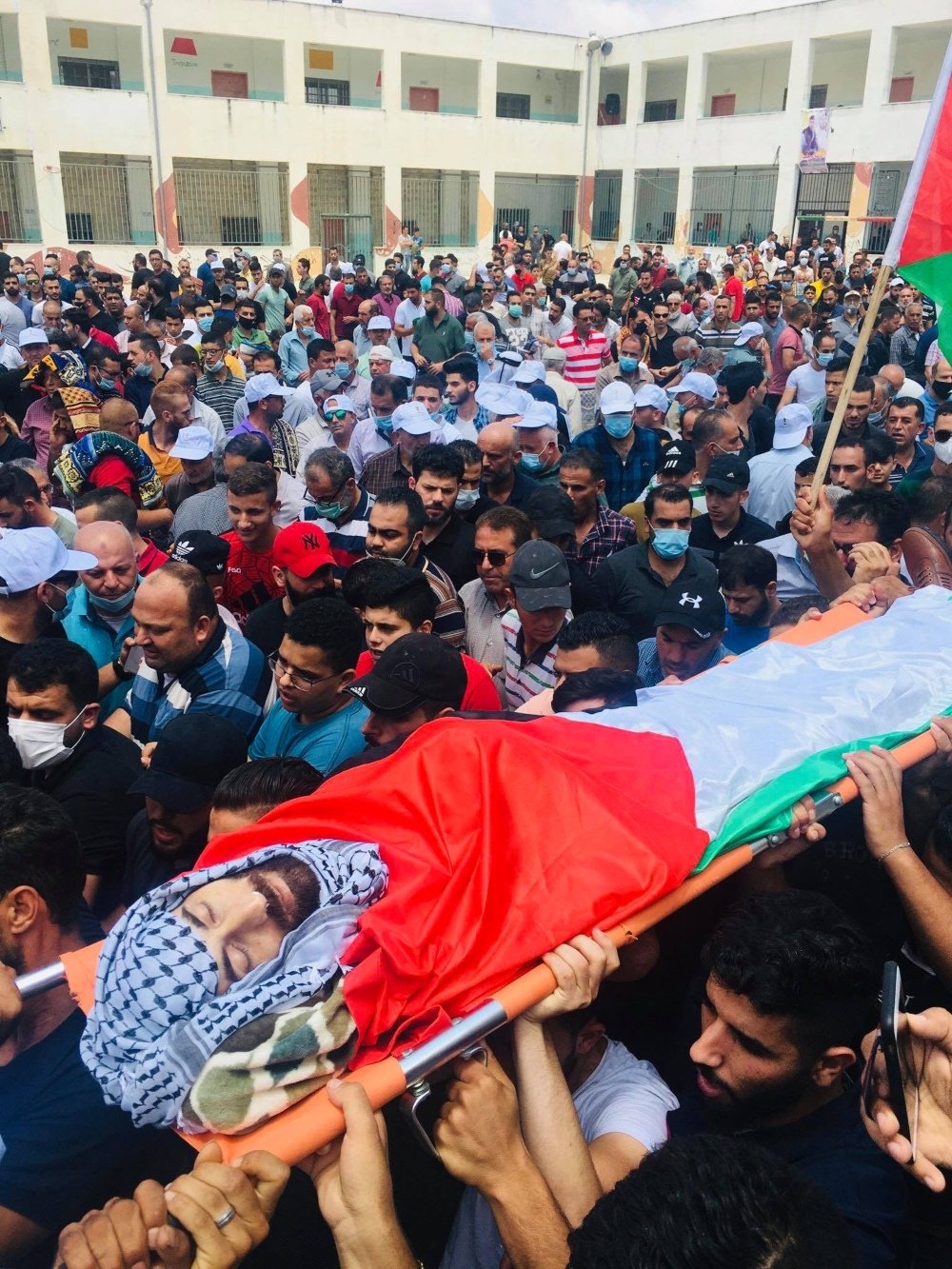
On Friday afternoon, hundreds of Palestinians gathered in the main square in Kifl Haris for Ibrahim’s funeral procession.
As they marched down the main road to the village cemetery carrying his body wrapped in a Palestinian flag, friends and family chanted slogans against the Israeli occupation and prayers for his safe passage into heaven.
“We are devastated, absolutely shocked,” Rami Abu Yaaqoub, Ibrahim’s cousin, told MEE. “Ibrahim was loved by everyone. He was hard-working, self-made, and had big goals for his life.”
According to Rami, Ibrahim was the primary caretaker of his widowed mother, who has a number of chronic health issues including diabetes and hypertension.
“His mother is beside herself. She doesn’t know what to do,” Rami said.
According to locals, another youth from Kifl Haris, identified as 17-year-old Mohammed Abd al-Salam, was shot in the legs close to the permanent military tower at the entrance to the village. He was reportedly denied medical care from the soldiers, and locals were similarly prevented from taking him to the hospital.
Only when Palestinian ambulances arrived was Abd al-Salam allowed to be evacuated to the hospital.
Following Ibrahim’s killing, the Israeli army claimed it opened fire in response to “two assailants throwing Molotov cocktails”.
But his friends and family strongly rejected these accusations.
“We were just walking to go to our friend’s house,” Abu Hammad said, adding that he hadn’t heard any sort of commotion or clashes with soldiers before Ibrahim was shot.
“We were not throwing stones or Molotov cocktails, and we didn’t hear or see anyone else doing that either,” he said.
Rami Abu Yaaqoub pointed to the fact that Ibrahim and Haitham were both walking on the main road of the village, which is well-lit with a number of street lights.
“They were walking in perfect visibility,” he said. “Wherever the soldiers were, they would have been able to see Haitham and Ibrahim clearly. If Ibrahim was throwing any kind of stones or something at the soldiers, they could have fired warning shots, or gone to arrest him. They didn’t have to kill him.”
The fact that Ibrahim was shot in the neck, Abu Yaaqoub said, proved that he was “executed”.
“He was shot in cold blood by a sniper whose one goal was to kill. They killed Ibrahim not because of who he was, or because he was dangerous to them. They killed him because he was Palestinian.”

